Astrofair 2009 Report by G7FEK
Posted by Mike G7FEK on Wed, 12 Aug 2009 16:49:45 +0100
Mike G7FEK was in attendance at the 2009 Astronomy Fair at the Norman Lockyer Observatory in Sidmouth. Here is my report...
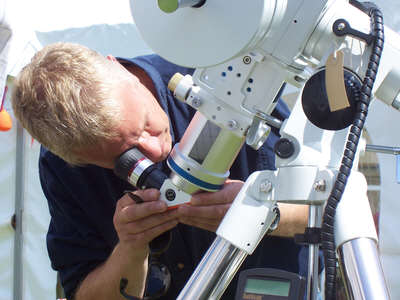 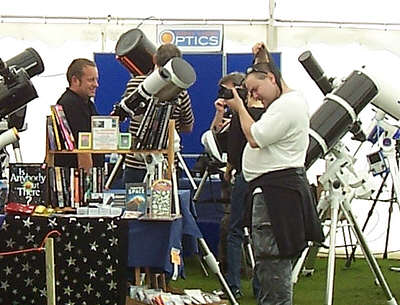 | 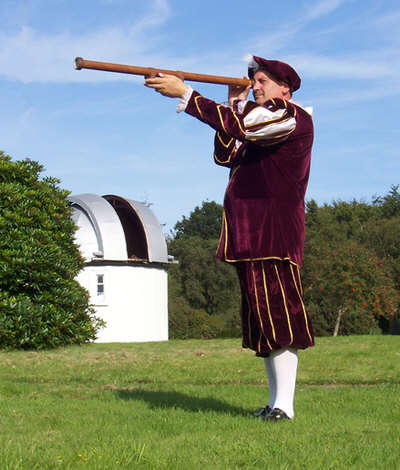 |
Saturday 8th August was the date for the 2009 South West Astronomy Fair at the Norman Lockyer Observatory in Sidmouth Devon, England.
The weather this year was exceptional for the whole weekend, and I have the sunburn to prove it!.
The lectures, talks and the planetarium were well attended demonstrating that there is a significant public interest in Astronomy and the workings of our Universe.
Sunspots (or lack of them!)

The Lockyer Telescope that we used for projecting the suns disc.
Mike, G7FEK was presenting in the Lockyer Telescope dome, charged with the job of talking about Sunspots and their effects on Earth. We were able to show clearly the blank disc of the Sun to everyone for the whole day, clearly demonstrating the present lack of sunspot activity. Interest in this subject was very high, keeping us busy all afternoon. Many questions were asked during the presentations, especially relating to the possibility of links with climate change and radio communications.
Discovery of Helium
Iain, M1OOO gave a detailed description of the Lockyer Telescope and how Helium was first discovered in the Sun by Norman Lockyer, 27 years before it was separated on Earth. He also gave a fantastic and easily understandable description of the Fraunhofer absorbtion lines used to determine the chemical make up of the atmosphere of stars and planets. This experiment was also reporoduced in the McClean dome during the event and the absorbtion lines were clearly visible. | Fraunhofer Absorbtion lines shown in the optical spectrum |
Planetarium
There were regular presentations in the planetarium throughout the day and I attended one of these myself. Specialising in Solar astronomy I have only a limited knowledge of other stars and deep space and it is very interesting to learn more about the sky at night.All in all the day was very enjoyable and well attended.
External Links:
Norman Lockyer Observatory Website
No one has left any comments yet
Click Here to comment on this story
V.0.82 © Copyright 2008 - 2021 G7FEK - 0.84